Kakheti, Georgia: where wine stays underground (and keeps its nerve)
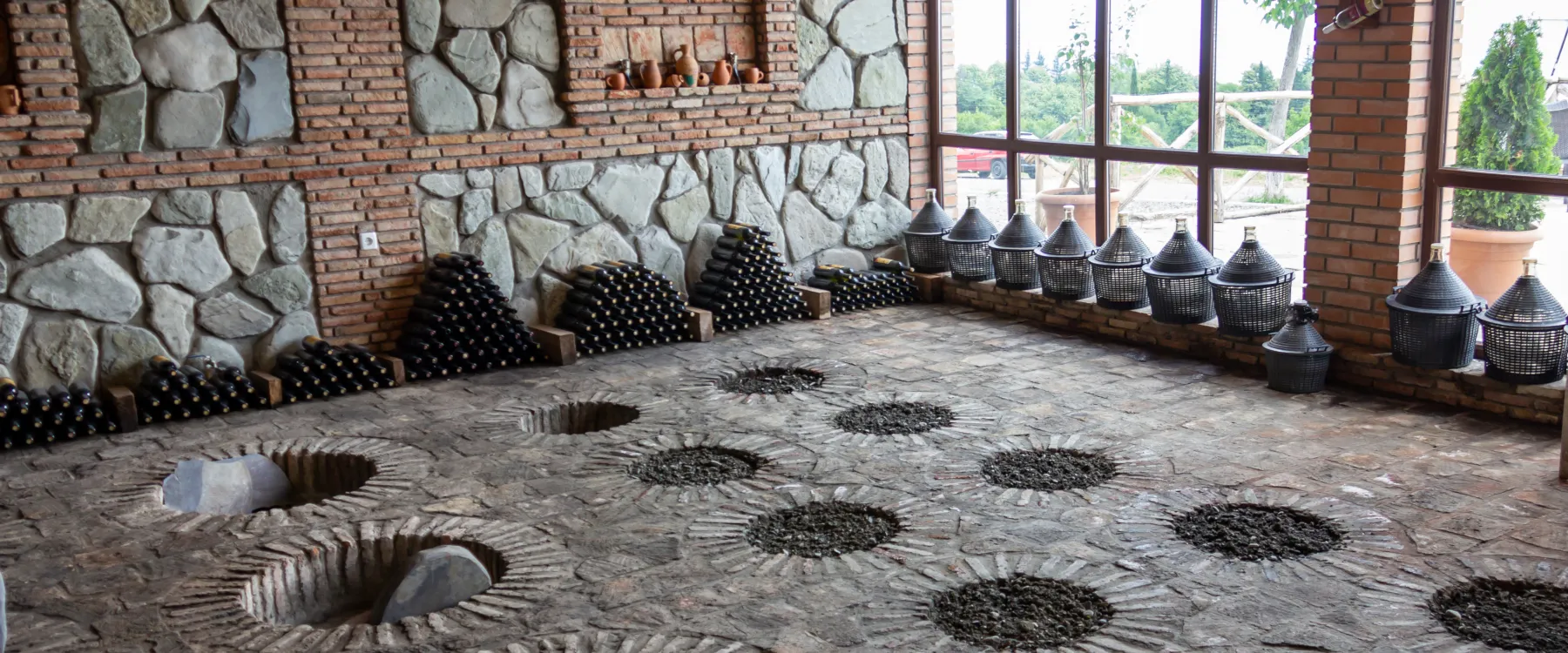
There’s a small, almost mischievous lesson Kakheti teaches anyone raised on the bright, visible theatre of modern cellars: look down. Not at a view—Kakheti has plenty of those—but at the floor. Traditional Georgian wineries announce themselves not with rows of barrels or stainless-steel shine, but with a pattern of circular lids set into the ground. Each circle marks a qvevri: an egg-shaped clay vessel buried up to its neck, where juice and skins ferment together and, months later, re-emerge as wine.
Seen from the doorway, it is both humble and audacious. The main tool of the winemaker is hidden, not showcased. The vessel behaves like a seed: covered, insulated, patient. In a world trained to read wine through labels and lighting, Kakheti’s most recognisable signature is subterranean—and still, unmistakably, alive.
The method isn’t a romantic approximation. On UNESCO’s Representative List, the process is described in plain, practical terms: grapes are pressed and the juice, along with skins, stalks and pips, is poured into the qvevri; the vessel is sealed and buried so the wine can ferment for five to six months. UNESCO also stresses how this knowledge circulates within communities—through observation and participation, right down to collecting clay and firing the qvevri themselves. In other words: this is not “heritage” as decoration; it is heritage as daily competence.
And yet Kakheti is not a museum. Eastern Georgia is where traditional practice coexists with modern scale without either one pretending the other doesn’t exist. The National Wine Agency outlines Kakhetian winemaking with a vocabulary that feels like a working manual: satsnakheli (press), badagi (must), chacha (skins, stalks and pips). After alcoholic fermentation, the chacha sinks; once malolactic fermentation finishes, the qvevri are sealed hermetically; the first racking comes in March; the wine then ages for about a year under systematic control. The same agency adds an important counterpoint: alongside “traditional Kakhetian wine”, Kakheti also produces European-style wines—often from the same grapes. One region, two grammars.
If you want to understand Kakheti’s weight in Georgian wine, a single unpoetic number does the job beautifully. According to FAO data, Georgia has around 55,000 hectares of vineyards, and about 76.7% of them lie in Kakheti. The “origin story” is not tucked away in a folkloric corner. It unfolds inside the country’s main production engine.
Then there is the word that can unsettle even the most confident European timeline: Neolithic. A 2017 paper in PNAS points to ceramic vessels from two sites south of Tbilisi—Gadachrili Gora and Shulaveris Gora—where biomolecular evidence consistent with grape wine is dated to roughly 6000–5800 BC. National Geographic recounts the investigation and names the people behind the data: archaeologist Patrick McGovern, who identified tartaric acid as a chemical fingerprint of wine residues; University of Toronto archaeologist Stephen Batiuk, who co-led the expedition with Mindia Jalabadze of the Georgian National Museum. This matters because it moves the conversation from myth to report: jars, residues, dates.
Back in Kakheti, the line between ancient jar and modern qvevri becomes less of a metaphor than a family resemblance. National Geographic notes a tactile, workshop-level detail: large qvevri are often lined with beeswax, buried up to the neck, and used for generations. Longevity here is not a slogan—it is built into the material.
Between Neolithic evidence and contemporary production, Kakheti also has a distinctly nineteenth-century chapter: the moment when “European” modernity enters in glass and archives. At Tsinandali, tradition credits Prince Alexander Chavchavadze (1786–1846) with introducing classical winemaking practices; and one detail is stated with archival precision: Tsinandali is presented as the place where Georgian wine was first bottled, with historic vintages—among them a Saperavi from 1841—kept in the estate’s oenotheque. It is more than a noble anecdote. It is Kakheti staging a quiet comparison between two definitions of permanence: wine that rests underground, and wine that is preserved, labelled, and remembered in bottles.
For a literal sacred/profane contrast, Alaverdi offers a clean, layered story. On UNESCO’s Tentative List documentation, Alaverdi Cathedral is placed in the Alazani River valley, 18 km from Telavi. The earliest monastic structures date back to the sixth century; the present cathedral belongs to the eleventh-century monastic complex, linked to King Kvirike and the monk Joseph (Abba) Alaverdeli. The same description notes that the fortified monastic enclosure includes wine cellars among its buildings. Here, wine is not a lifestyle accessory—it is part of the monastery’s lived infrastructure.
Modern Kakheti, however, announces itself not with legend but with harvest numbers. On 9 October 2025, the National Wine Agency reported that up to 247,000 tons of grapes had been processed in Kakheti: up to 123,000 tons of Rkatsiteli and about 108,000 of Saperavi, with the rest spread across other varieties. The scale is a useful corrective. “Cradle of wine” may be a proud phrase, but it is also a functioning supply chain, a region that keeps producing while insisting—stubbornly—that production does not have to mean uniformity.
Because Kakheti speaks not only in symbols, but in appellations—microzones defined by geography and rules. In Sakpatenti’s documentation, Tsinandali is described as a dry white appellation wine made from Rkatsiteli, with up to 15% Kakhuri Mtsvane permitted. Kindzmarauli, in Kvareli, is a naturally semi-sweet red made from Saperavi. Mukuzani, in Gurjaani, is defined as a high-quality dry red, with the technical section built around the Saperavi variety. Kakheti doesn’t ask you to believe. It hands you coordinates, thresholds, and specifications.
Perhaps that is Kakheti’s most durable surprise: “origin” here comes in two opposite, complementary forms. One is the buried vessel that hides wine from sight and trusts the earth’s steady temperature. The other is the modern order of denominations, statistics, and legal definitions. The two don’t contradict each other. They describe the same instinct: to organise time. Whether through an amphora under the floor or a microzone on paper, Kakheti keeps doing what it has done for millennia—making wine a way to stay put in history.