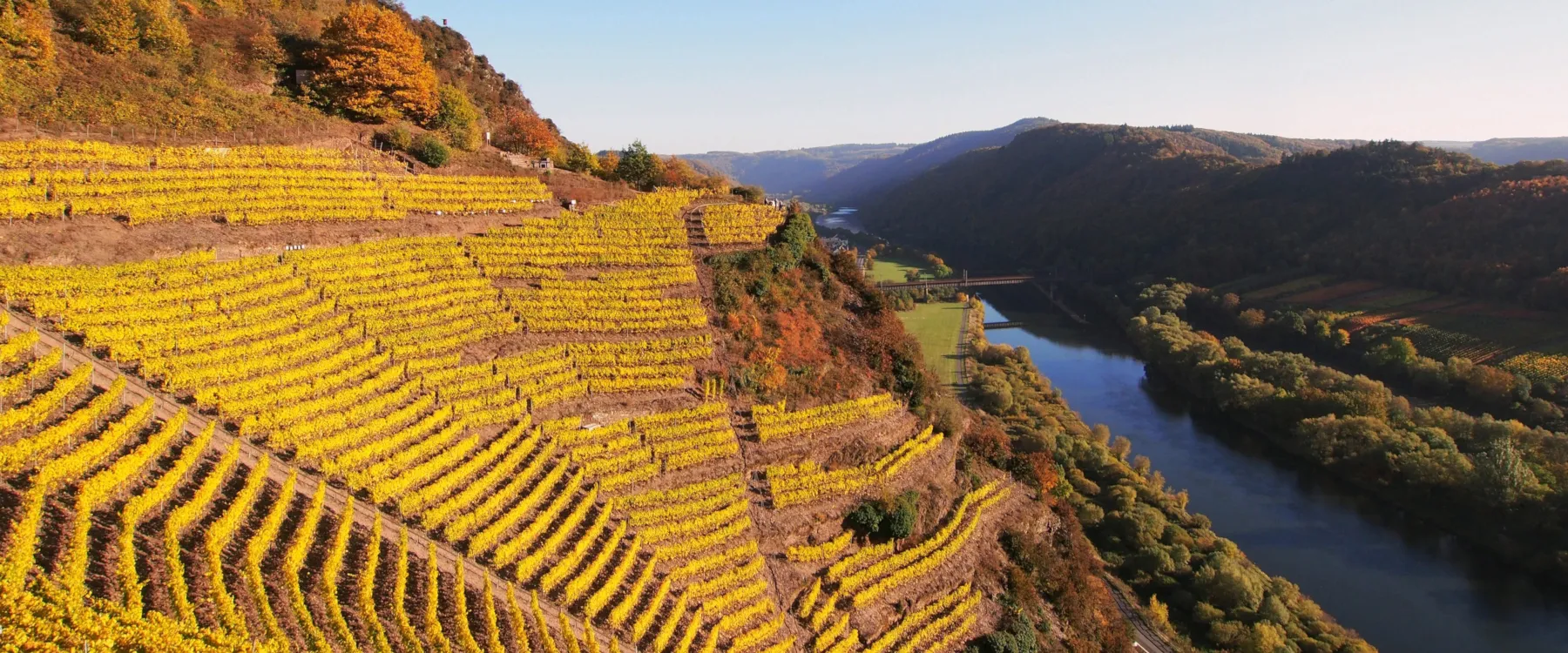
There is a point on the road hugging the Mosel river bend between the villages of Bremm and Ediger-Eller where the sat-nav suggests proceeding on foot. Not out of whimsy: the Calmont vineyard simply rises at a 65-degree incline, the steepest in Europe. Viewed from below, it takes your breath away. Viewed from above, as vineyard workers abseil down with ropes and harnesses at harvest time, it overturns any faith in human rationality.
Yet here, on these impossible slopes where every operation takes three times as long and statistics still record fatal accidents among workers, some of the planet's most extraordinary Rieslings are born. This is no paradox: it is the most radical demonstration of how gradient, aspect and ripening speed form the invisible pillars supporting a wine's greatness.
The principle is simple in theory, endlessly complex in practice. A vineyard tilted southward in the northern hemisphere captures more sunlight than a flat one. The angle of incidence increases, and with it the accumulation of heat in the soil. But that is not all: on the Mosel slopes, the slate rocks jutting between the rows absorb warmth during the day and release it slowly through the night, creating a kind of natural underfloor heating for the roots. This allows Riesling to be cultivated at latitudes (49–50°N) where, without these geological and topographical aids, the grape could never ripen.
The Cistercian monks understood this as early as the Middle Ages, when they began mapping Burgundy's parcels with obsessive precision. They noticed that vineyards mere dozens of metres apart produced radically different wines. The explanation almost always lay in position on the slope: the finest plots, those we now call Grand Cru, occupy the mid-section of the hillside, where an east to south-east aspect ensures morning sun without afternoon excess, and where the limestone-marl soil strikes the perfect balance between drainage and water retention.
"Before fifteen or twenty years of age, vines never make truly good wine," maintained Sebastian Stocker, the legendary cellar master at Cantina Terlano in Alto Adige. Old vines drive their roots deep, reaching mineral strata inaccessible to younger plants. But root depth is also shaped by gradient: on steep ground, where water drains rapidly, vines must search for moisture far below, developing root systems that may extend tens of metres. The result is greater mineral complexity in the wine — that sensation of "wet stone" tasters describe in great Mosel Rieslings or in the Nebbiolo of Valtellina.
Valtellina itself offers perhaps the most extreme example of heroic viticulture in Italy. Eight hundred hectares of vineyard cling to the Rhaetian Alpine slope, supported by roughly 2,500 kilometres of dry-stone walls built by hand over centuries. The terraces are so narrow that some hold only a single row. Here Nebbiolo, locally called Chiavennasca, ripens at altitudes reaching 750 metres — where, in theory, it should never complete its growth cycle. It manages thanks to strictly southern exposure, the shelter of the Rhaetian Alps from cold winds, and breezes from Lake Como that dry the bunches and reduce disease risk.
The outcome? Wines that resemble Burgundy Pinot Noir more than their Piedmontese cousins. "The tannins of Valtellina Nebbiolo are supported by fresh acidity and minerality that make the wines similar to great Pinot Noirs," confirms Danilo Drocco, winemaker at Nino Negri, one of the area's historic cellars. The reason lies in the pace of ripening: altitude lowers temperatures (roughly 0.6°C for every hundred metres of elevation), slowing sugar accumulation and preserving the grape's natural acidity.
This is the crux: what matters is not just how much light a cluster receives, but for how long. Slow ripening allows the full development of aromatic precursors — those invisible molecules that during fermentation become the scents we recognise in the glass. When heat accelerates the process, sugars reach optimal levels before the skin has fully developed tannins and aromas. This is what vignerons call the decoupling of sugar ripeness and phenolic ripeness: a problem that climate change is making ever more pressing, even in historically temperate zones.
Cool nights play a crucial role. When temperatures drop, plant metabolism slows, halting the combustion of organic acids that occurs during the day. In Argentina's Uco Valley, where diurnal swings reach 30°C, this produces Malbec with an electric acidity unthinkable in more uniform climates. The same principle explains why east-facing slopes, catching morning sun while the air is still fresh, are often preferred to western ones, exposed to the harsher heat of afternoon.
In Gevrey-Chambertin, in Burgundy, the nine Grand Crus occupy the mid-to-upper slope, sheltered by the woodland crowning the hill, which blocks cold winds and hail. The Premier Crus lie slightly lower or on marginally less favourable exposures. Village vineyards, producing the simplest wine, extend down to the valley floor, where more fertile alluvial soils yield larger crops but less concentrated wines. It is a hierarchy written in the earth, intuited by medieval monks centuries before modern science could explain it.
But beware of turning this knowledge into dogma. In the world of wine, as in life, rules exist to be intelligently broken. On the Mosel itself, producers are rediscovering north-facing slopes once deemed marginal, now finally suited to viticulture as global warming takes hold. In Valtellina, Nino Negri's historic winemaker Casimiro Maule revolutionised local practice by planting rows east-to-west rather than up-and-down the slope: heresy according to tradition, yet it allows canopy shading to be managed and small tracked tractors to be introduced where only manual labour was once possible.
And so, as I sip a Riesling from the Wehlener Sonnenuhr — literally "Wehlen sundial," from the great solar clock painted on the vineyard rock — I think of how much calculation, how much toil, how much patience reside in this glass. The sundial is merely a symbol: the true clock of these wines is written in the angle of the slope, in the arc of the sun, in the slow passage of weeks from véraison to harvest. Every degree of gradient, every hour of light, every cool night leaves its mark on the wine. And perhaps that is exactly why, despite the inhuman effort, there are still those who clamber up these walls of slate, secateurs in hand. Because they know that nowhere else would the sun kiss stone in quite the same way.