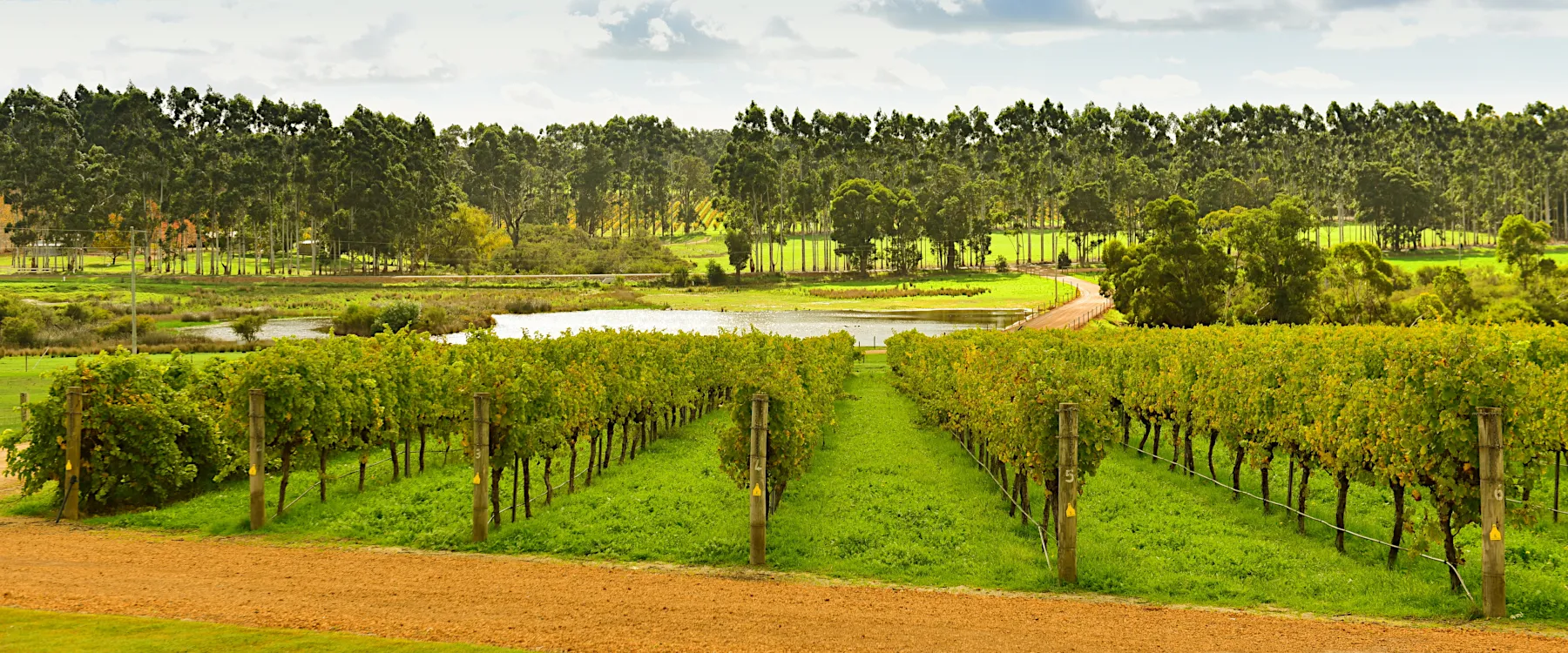
Margaret River: where wine moves to an ocean rhythm
At Cape Leeuwin, wind is not part of the scenery; it runs the place. It comes in hard and clean, shouldering its way past the lighthouse, carrying salt, distance and a sense of scale that makes human ambition look pleasantly modest. This is mainland Australia’s south-western edge, where the Indian and Southern Oceans meet. It is also the right place to begin if you want to understand Margaret River, because this region makes sense only once you realise that the sea is not a backdrop here. It shapes the viticulture as much as the soil does.
That may be Margaret River’s real distinction. Plenty of places can offer dramatic coastline, surf breaks, forests and good restaurants. What is rarer is this particular combination of grandeur and restraint. The beaches are dazzling, the Leeuwin-Naturaliste ridge is ancient, the caves run deep beneath the limestone, the karri forests, with their majestic eucalyptus trees rise like a second architecture, and yet nothing feels overblown. The wines have absorbed that same instinct. Even at their most powerful, they rarely shout. They tend to hold themselves together.
Long before vines arrived, this was — and remains — Wadandi Boodja, Country of the Wadandi people. The region’s tourism body acknowledges 60,000 years of Wadandi custodianship, a timespan large enough to make the modern wine story feel like yesterday afternoon. That is not a sentimental preface. It matters. Margaret River has become one of the best-known fine wine regions in the southern hemisphere, but it sits within a much older landscape, one shaped by songlines, forests, ocean weather and a biodiversity that is unusually rich even by Australian standards.
The modern wine story begins not with myth but with research. In 1955 Harold Olmo, the influential University of California viticulturist, identified Western Australia’s south-west as having serious fine-wine potential. Then came Dr John Gladstones, the agronomist whose reports in 1965 and 1966 did something more dangerous than dream: they persuaded people with evidence. He studied climate and soils, singled out the Margaret River/Vasse district and even pointed to promising localities. If there is a founding prophet of the region, he was armed with data rather than charisma.
The first converts were doctors. Tom Cullity, a cardiologist, and Bill Pannell spent weekends searching for the right land. The image is almost absurdly unglamorous: medical professionals driving around a remote corner of Western Australia, trying to decide whether this might one day sustain world-class Cabernet. Yet that is exactly how Margaret River began. In 1967 Cullity planted the first modern commercial vineyard at Vasse Felix, including Cabernet Sauvignon and Malbec. Those original vines are still there. Moss Wood followed in 1969, then Cape Mentelle in 1970, Cullen in 1971 and Leeuwin Estate in 1973. By 1980 there were already 20 vineyards operating in the region. For somewhere so isolated, it was a remarkably swift beginning — though never a reckless one.
Why did it work? Largely because the place has the kind of climate that winemakers are taught to speak about with a mixture of gratitude and caution. Wine Australia describes Margaret River as one of the most geographically isolated wine regions in the world and notes that it has the most strongly marked maritime climate in Australia in terms of rainfall. In practice, that means the sea moderates extremes. Summers are warm rather than brutal, the diurnal range is low, heat accumulation is even, and the overall pattern has often been compared with Bordeaux in a dry year. That comparison is not marketing theatre; it runs back to Gladstones’ work and remains one of the region’s most useful reference points.
The soils matter too. Along the ridge from Cape Naturaliste to Cape Leeuwin, gravelly loams over granite and gneiss drain freely and hold only limited water. Vines are not pampered. They are asked to find their own poise. Unsurprisingly, the region’s two leading varieties — Cabernet Sauvignon and Chardonnay — have become specialists in poise.
Cabernet is the hero red here, often blended with Merlot but equally compelling on its own. In Margaret River it tends to deliver blackcurrant fruit, violet lift, a gravelly or earthy thread and a structure that is firm without becoming cumbersome. It is powerful, yes, but not in the broad-shouldered Australian stereotype. Chardonnay, meanwhile, has become one of the region’s most persuasive calling cards. The first plantings came in 1976 at Leeuwin Estate, Cullen and Moss Wood, and since then Margaret River has built an enviable reputation for Chardonnays that combine intensity with line. Wine Australia points to the importance of the Mendoza clone, known locally as Gin Gin, in shaping wines of striking complexity and lime-like acidity.
Yet Margaret River is not a two-note region. Semillon and Sauvignon Blanc, very often blended together, remain one of its most distinctive white categories: crisp, energetic and more varied in style than they are sometimes given credit for. Chenin Blanc is gaining ground. Shiraz — often labelled Syrah in a nod to style as much as nomenclature — can be notably medium-bodied and composed. More than 40 grape varieties are planted across the region.
Despite its global prestige, Margaret River’s scale remains decidedly boutique. In the 2024 vintage, 174 wineries recorded production, and around half the region’s wineries handle less than 50 tonnes of grapes. This is not an industrial giant disguised as a boutique idyll. Margaret River is genuinely small in production terms. Its reputation is built less on volume than on consistency, site selection and the unnerving frequency with which its best wines punch above their weight.
The turning point came in the 1980s, when the outside world stopped treating Margaret River as an interesting experiment. Cape Mentelle won the Jimmy Watson Trophy — Australia’s most coveted young red wine award — in consecutive years, 1983 and 1984. Leeuwin Estate’s Art Series Chardonnay helped propel the region’s whites onto the international stage. From then on, Margaret River was no longer trying to prove it could make fine wine. The question became how far that fine wine identity could extend.
Part of the answer lies with the region’s producers, many of whom have remained unusually committed to site, detail and long-term thinking. Cullen Wines, founded in 1971 by Kevin and Diana Cullen, has become one of Margaret River’s touchstone estates; the Cullen vineyard has been certified biodynamic since 2004, following the move to full organic viticulture in 1998. Vasse Felix still draws authority from its original 1967 plantings. Leeuwin Estate, family-owned since its establishment, fused wine, art and hospitality without tipping into gimmickry — no small achievement in a place so naturally photogenic.
Even the internal geography resists simplification. There are no official subregions within the Margaret River GI, though Gladstones proposed six climate- and soil-based districts in 1999: Yallingup, Carbunup, Wilyabrup, Treeton, Wallcliffe and Karridale. The proposal never became formal law, but the names continue to circulate because they answer to a truth that drinkers can taste and growers can see: Margaret River is coherent, but not uniform.
Perhaps that is why the region has aged so well as an idea. It never needed to perform Australianness in the loudest possible register. It did not have to be the hottest, biggest, boldest or most extractive thing in the room. The ocean checked that temptation. The landscape did too. The Leeuwin-Naturaliste National Park edges the region with beaches, wetlands, caves and towering karri forest; vineyards sit inside this broader environment rather than dominating it. For once, the word “terroir” earns its keep.
In a country that has often liked scale, Margaret River has built greatness through proportion. The region’s wines account for just 2% of Australia’s annual crush, according to the Margaret River Wine Association. It is not much. But it is enough when a place knows exactly what it is doing. Ultimately, Margaret River proves that extreme geographical isolation isn't just a logistical challenge, but a viticultural asset. At the edge of the continent, where two oceans meet, this region has found the perfect formula to turn coastal intensity into world-class elegance.