Dão, Where Granite Teaches and Elegance Returns
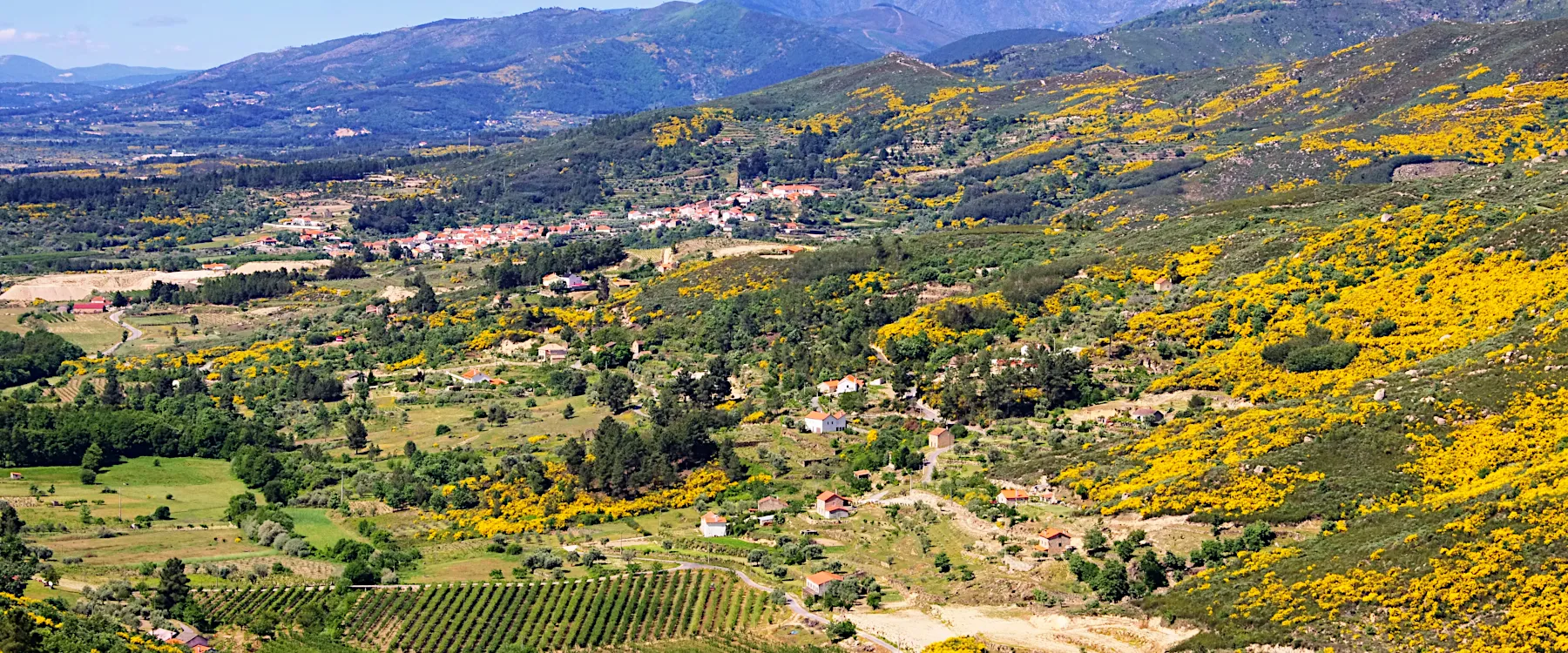
You arrive in the Dão carrying the kind of bias we reserve for “in-between” regions: not as globally branded as the Douro, not as Atlantic-glamorous as the coast. Then you step out of the car and the place resets your expectations with unshowy essentials—granite breaking through the soil, pine forests closing the horizon, altitude cooling the air into clarity. The ocean exists, somewhere beyond the mountain ramparts—Estrela, Caramulo, Nave, Buçaco—but Dão turns its back on it politely, not out of disdain, but for shelter.
The first glass refuses to behave like the generic idea of “Portuguese red”. No push, no roar, no oak-polished theatrics. Instead it moves like a well-built sentence: it enters, stretches, and leaves behind a fine trail of herbs, graphite, and dark fruit kept on a short leash. “That’s Dão when it decides to be Dão,” a producer tells me with the calm, faintly amused air of someone who doesn’t need to persuade you. Which is, of course, the quickest way to do it.
Before it was “rediscovered”, Dão was defined—formally, precisely. A Letter of Law dated 18 September 1908 established the Demarcated Region; a regulatory decree followed on 25 May 1910. Not a decorative footnote: Dão became Portugal’s first demarcated and regulated region for non-fortified wines. Today that primacy feels less like bragging rights than a key to the local mindset—rules and boundaries, yes, but also patience.
Patience, however, is not the same as stasis. In the 20th century Dão lived through a paradox: it had a name, yet it risked losing its voice. In the 1940s, under Salazar’s regime, a cooperative system was imposed that effectively concentrated vinification and trade in structures granted exclusive privileges. The intention was control and national coherence; the collateral damage was a lack of competition and a long season of mediocrity. The decisive break comes late, and not out of romance: by the late 1970s, in the context of Portugal’s approach to the European Community, those monopolistic rules were dismantled. Geopolitics, accidentally, improved the wine.
Look at the vineyards and you understand why elegance here is not a pose but a consequence. Soils are poor and largely granitic, with schist outcrops; vines can reach around 800 metres, though the comfortable working range is often lower, roughly 400–500. Three rivers—Dão, Mondego, Alva—thread the region into a mosaic of exposures and microclimates. And the mountains are not brochure scenery: they act as a climatic shield, keeping extremes at bay and allowing full ripeness without sacrificing freshness.
In that context, “terroir talk” can feel redundant. Better to speak about grapes—the region’s real vocabulary. Touriga Nacional, inevitably: Dão is frequently cited among its birthplaces, and in the glass it often shifts from power to poise. But the recovered elegance also runs through varieties that deserve better PR: Alfrocheiro (depth without heaviness), Tinta Roriz (Tempranillo with a Portuguese accent), Jaen (Mencía by another name, with a slightly different grammar). And then there’s Encruzado on the white side—a grape that doesn’t perform until you pay attention, and then makes “attention” feel like the correct word.
At Quinta dos Roques, between Mangualde and Nelas, the story becomes tangible. The estate presents itself as a third-generation family winery, proud of working with traditional varieties—and of having been among the pioneers of varietal wines in Dão during the 1990s. In a culture where blending is an instinct, varietals aren’t a fashion statement; they’re a way of sharpening focus. An older visit report names names—Luís Lourenço, owner and general manager, and consultant winemaker Rui Reguinga—and reminds you how common it once was to interplant red and white grapes in the same vineyard. Not folklore: a practical route to lighter-coloured wines, in line with the tastes of the time. Dão, in other words, has been “elegant” long before we used the word as marketing.
Modernity also arrives through farming, not trends. Casa de Mouraz offers a timeline you can verify: Ecocert organic certification in 1997, biodynamic preparations from 2006. In a world where “organic” can be a flexible adjective, Dão turns it into dates—history you can pin to paper. It’s no accident that one word keeps returning alongside freshness: balance.
Cooperatives, meanwhile, haven’t vanished. They’ve changed function—and, in some cases, scale. The Dão wine commission presents the Adega Cooperativa de Penalva do Castelo as founded in 1960, receiving grapes for the first time in 1967. This is also Dão: institutional memory that remains, within a landscape that now holds cult growers, serious mid-sized producers, and estates that treat precision not as a style choice but as a baseline.
And then there’s architecture—because in Dão a winery can alter your pace of looking. Taboadella, in the Sátão area, has a winery designed by architect Carlos Castanheira (a project dated 2020, widely documented). Sustainability could easily slip into cliché; here it becomes material choices and spatial intelligence rather than slogans. And the contrast works: a region once perceived as strictly “classic” now hosts a measured contemporary confidence that doesn’t clash with the forested plateau around it.
By the time you leave, what stays with you is not the easy thrill of a “place to recommend”, but a quiet gratitude for a region that didn’t simplify itself to please you. It asked instead for a small act of attention—and returned an elegance that feels less like nostalgia than precision: the rare kind of wine speech delivered in a low voice, compelling you to listen all the way through.