Where the Land Turns Black and Wine Makes No Apologies: Swartland, Old Vines, and the New South Africa
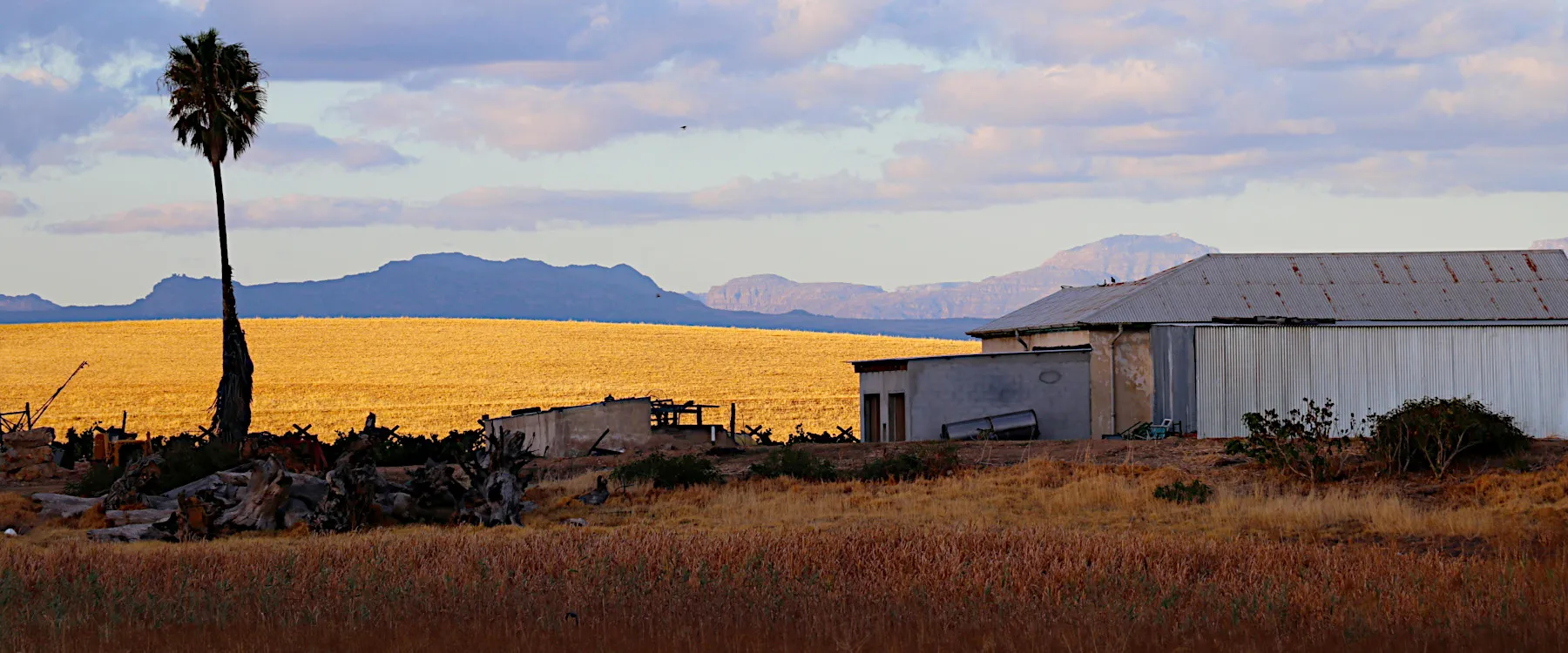
In the Swartland, north of Cape Town, the landscape shifts its mood with the season. After the first winter rains, the low scrub darkens across the rolling hills, and the region briefly reclaims the meaning of its name—"Black Land," as the early Dutch settlers dubbed it. Then the wind arrives, stripping away the humidity and drying everything back into sharp focus: wheat-gold, dust, and blindingly bright skies. It is a country of rapid contrasts, and the wines here seem to have adopted the same temperament: they rarely aim to merely flatter.
You sense this attitude in the gateway towns of Riebeek-Kasteel and Riebeek West. These communities reject the polished veneer typical of the Cape Winelands; they feel lived-in rather than curated. Art spaces sit alongside working agricultural supply stores, tasting rooms are informal, and the geography is spoken aloud like a compass: Paardeberg, Kasteelberg, Malmesbury, Porseleinberg. Here, wine isn’t presented as a monument. It is presented as a deliberate choice.
For decades, the Swartland was the Cape’s agricultural engine room, defined by vast wheat fields and vineyards geared toward volume. The history of local cooperation, anchored by the Swartland Co-operative founded in 1948, tells the story of that era: consolidation, bulk delivery, and mass production. There is no original sin in this industrial logic—it was simply an economic necessity. Yet, the fracture that opened in the 2000s led elsewhere: toward wines that refused to be "South Africa" in the abstract, insisting instead on expressing this specific place—hot, dry, and unforgiving to those who look for shortcuts.
The narrative arc most often cited began in 2010 with the Swartland Revolution, a festival that served as an amplifier for a group of producers committed to old vines, dry-farming, and a stripped-back aesthetic. The names here matter because they represent people before brands: Eben Sadie, Adi Badenhorst, Chris and Andrea Mullineux, and Callie Louw. In November 2015, the founders issued an official statement ending the event. Sadie later summarized the decision with a line that sounded like a quip but was actually policy: "Revolutions can’t go on forever." Yet the story didn't end there. The return of the "Swartland Revolution" moniker for the 2025 reunion proved that in a dynamic region, the narrative is never truly finished.
If the Revolution was the spark, the daily reality is defined by discipline. Swartland’s most distinctive move has been to treat freedom as something measurable. The Swartland Independent Producers (SIP) established rigorous criteria to define "place." These aren't just slogans, but requirements: wines must be 100% Swartland Wine of Origin; produced, matured, and bottled within the region; and made using a clearly defined "natural" approach. The prohibited list is extensive, banning added yeast, acidification, tannin adjustments, and reverse osmosis. Even oak is kept on a tight leash: no more than 25% new barrique, and strictly European wood. It is liberty, certainly—but within a defined framework.
That framework is, ultimately, geological. In the Swartland, discussing soil isn't a fashionable affectation; it is a practical necessity. Two terms dominate: Malmesbury shale and decomposed granite. The Paardeberg’s granites generally yield whites with tension and nerve, and reds that rely on line rather than muscle. The Kasteelberg and parts of the Riebeek Valley introduce shale: different water retention, different heat response, different tannin texture. A recent Decanter report went so far as to describe Riebeeksrivier as the district’s "Côte"—a strip of prized vineyards whose reputation for precision has earned it a Old World-style moniker.
Then come the grapes, which are workhorses rather than divas. Chenin Blanc and Syrah form the structural pillars, while a broader Mediterranean cast circles them: Grenache, Mourvèdre, Cinsault, Carignan, Viognier, Marsanne, Roussanne, and Pinotage—seen here in both traditional styles and lighter, new-wave interpretations. The shift is significant: variety alone no longer explains the wine. In the Swartland, the "where" has reclaimed precedence over the "what."
This focus on origin transforms "old vines" from a romantic notion into a protected category. South Africa’s Old Vine Project has drawn a firm line: an "old vine" must be 35 years or older to carry the Certified Heritage Vineyards seal. In a region where many historic parcels were once deemed economically unviable, that seal functions as cultural reparation, declaring that a vineyard is not merely production equipment, but a living archive.
"New South Africa" can sound like an oversized headline, so it is better understood here as a concrete shift. Swartland is where South African wine proved it could succeed without costumes. It did so not by finding a single formula, but by accepting its own plural nature—rough-edged and occasionally contradictory. It is the wheat heritage and the independent cellars; the media-savvy festival and the strict association rules. It is a place where wine doesn't ask for permission, provided it can answer a more demanding question: not "how modern are you?", but "to what do you truly belong?"