Roussillon: Where the Wind Changed Direction
The first hint that something was shifting arrived in an unlabelled bottle, opened in a cellar carved into black schist at Calce. We were thirty kilometres from Perpignan, in the heart of what had been the homeland of fortified sweet wines for centuries, and Gérard Gauby was pouring a red that resembled nothing one might expect from these parts. None of the luscious sweetness of Banyuls, none of the alcoholic power of Rivesaltes. Instead, a taut, mineral wine that seemed determined to tell a different story.
"When I started making dry wines in the eighties, people thought I was mad," Gauby recalls, his hands still dirty from the vineyard because here, at Domaine Gauby, the work in the vines is never delegated. "Roussillon was sweet by definition. The négociants only wanted concentrated musts for fortification. The idea of making a serious table wine seemed eccentric."
Yet that eccentricity eventually spread across an entire region. Today Roussillon is one of the most dynamic territories in the French wine landscape, a laboratory where centuries-old tradition coexists with radical experimentation. The metamorphosis has been neither painless nor complete. But driving the winding roads that climb towards the Pyrenees, past rows of century-old grenache clinging to vertiginous terraces, one senses that something profound has changed in the soul of this borderland.
Roussillon has always had a frontier vocation. Catalan in language and culture, French by political allegiance since 1659, this wedge of Mediterranean squeezed between mountains and sea built its wine identity on diversity. The Vins Doux Naturels—Banyuls, Maury, Rivesaltes, Muscat de Rivesaltes—are not simply sweet wines but the product of mutage, the addition of spirit during fermentation to preserve the grapes' natural sugars, practised here since the thirteenth century. It was Arnau de Vilanova, physician at the court of the Kings of Majorca, who codified the technique around 1285. Since then, generations of vignerons have refined the art of transforming grenache into amber nectars capable of defying the decades.
Markets, however, have short memories and fickle palates. From the 1960s onwards, sweet wines began losing ground. Consumption fell, prices collapsed, young people abandoned the vines. Roussillon risked becoming an oenological museum, guardian of magnificent but increasingly marginal traditions.
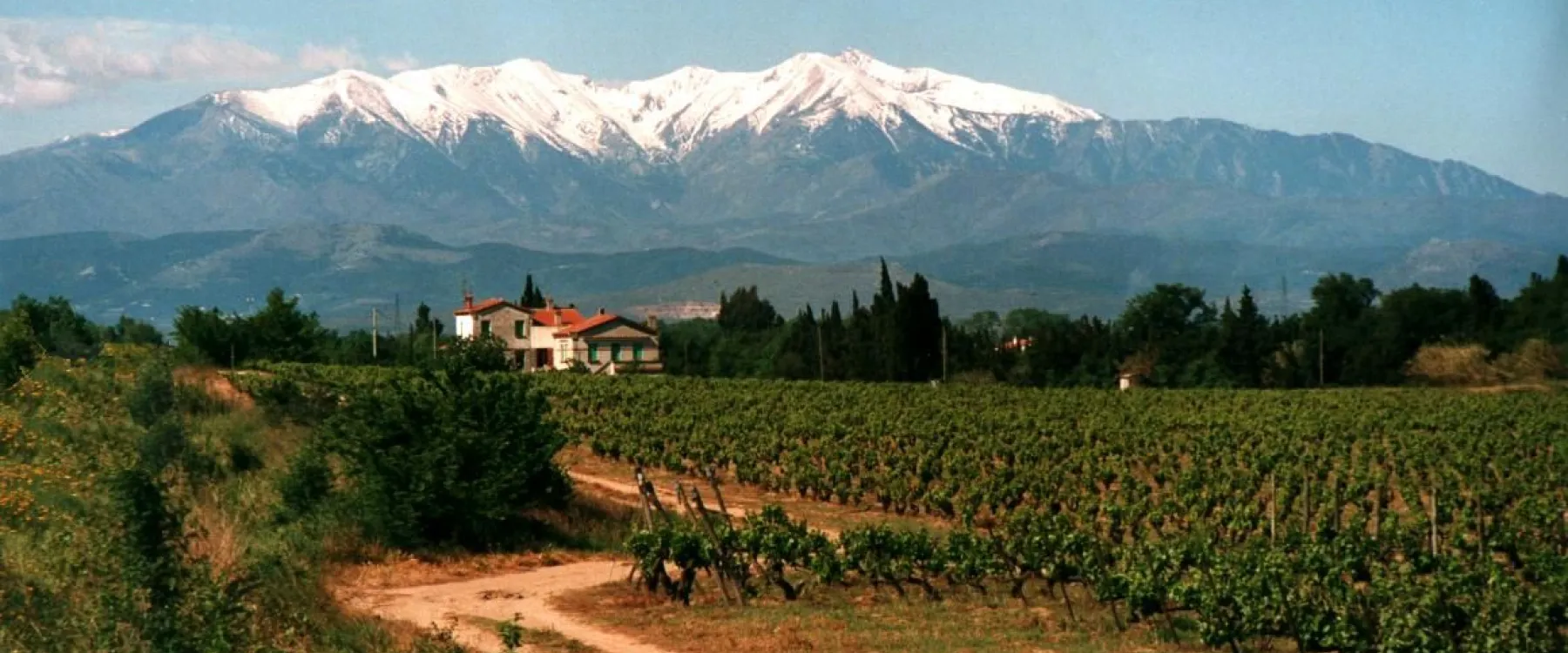
The turning point came from those who learned to look at the same land with fresh eyes. Beyond Gauby, other pioneers realised that those ancient vineyards, that black schist absorbing the sun's heat, that tramontane wind drying the clusters and keeping disease at bay, could yield far more than musts for fortification. At Maury, where grenache noir reigns supreme over hills that seem sketched by an expressionist painter, Mas Amiel has supplemented its historic sweet wine production with a range of dry reds that have won international acclaim. At Collioure, where vines plunge precipitously towards the Mediterranean in one of Europe's most spectacular landscapes, the appellation has always permitted dry wines alongside Banyuls, yet only in the past two decades have these intense, saline reds found their audience.
Those arriving in Roussillon today discover a region in ferment. In the Côtes du Roussillon Villages, the appellation that long ago established specific geographical hierarchies for terroirs such as Lesquerde, Latour de France, or Caramany, producers working with organic or biodynamic approaches are multiplying. They are pursuing a vision of wine that is, first and foremost, an expression of place. At Clos des Fées, Hervé Bizeul—a former sommelier turned vigneron—crafts reds of extraordinary elegance from century-old Carignan vines. He proves that this often-maligned variety, when sourced from ancient plants with minuscule yields, can deliver remarkable results. At Calce, alongside Gauby, a small community of winemakers has settled, including Tom Lubbe of Domaine Matassa and Olivier Pithon, drawn by the quality of the schist and the possibility of working Grenache and Carignan with minimal intervention.
Transformation, however, does not mean renunciation. One of the most fascinating aspects of contemporary Roussillon is precisely its ability to allow both souls—sweet and dry—to coexist without one having to yield to the other. At Domaine Cazes in Rivesaltes, Emmanuel Cazes continues producing the great oxidative wines of family tradition—some aged for decades in dame-jeannes exposed to sun and weather—alongside whites and dry reds that speak an entirely different language. It is a coexistence requiring balance and, above all, the awareness that a territory's identity is never monolithic.
Then there is the matter of grenache, the variety that more than any other embodies Roussillon's soul. Here the grape finds ideal conditions: Mediterranean warmth enhances its generosity, the tramontane concentrates its aromas, poor stony soils force roots to plunge deep in search of water and nourishment. The result is fruit of incredible intensity, capable of yielding wines approaching sixteen degrees of alcohol while retaining surprising freshness. Yet grenache is also a temperamental variety, oxidising easily and demanding skilled hands in the cellar. The new generation of vignerons has learned to tame it, often turning to amphora or concrete fermentation, avoiding new oak that would mask its character.
As the sun sinks behind the Canigou massif, tinting the black rocks of Maury pink, I find myself thinking again of that unlabelled bottle tasted in Gauby's cellar. It contained a Muntada, the wine that more than any other helped shift the world's perception of Roussillon. A masterful field blend from very old vines, vinified as one might treat a Burgundian Grand Cru. It commands Burgundy prices, too, and perhaps that is the most tangible sign of a revolution achieved.
But the real question, the one that hovers among the vine rows and in cellars carved from rock, is another: when the last bottle of forty-year-old Rivesaltes Ambré has been uncorked, what will remain of this land's sweet memory? Perhaps a recollection, like the one Gauby treasures of the grandfather who taught him to prune. Or perhaps something more: the understanding that change does not mean betrayal, but simply finding new paths to tell the same story.