Velvet Hands, Hearts of Steel
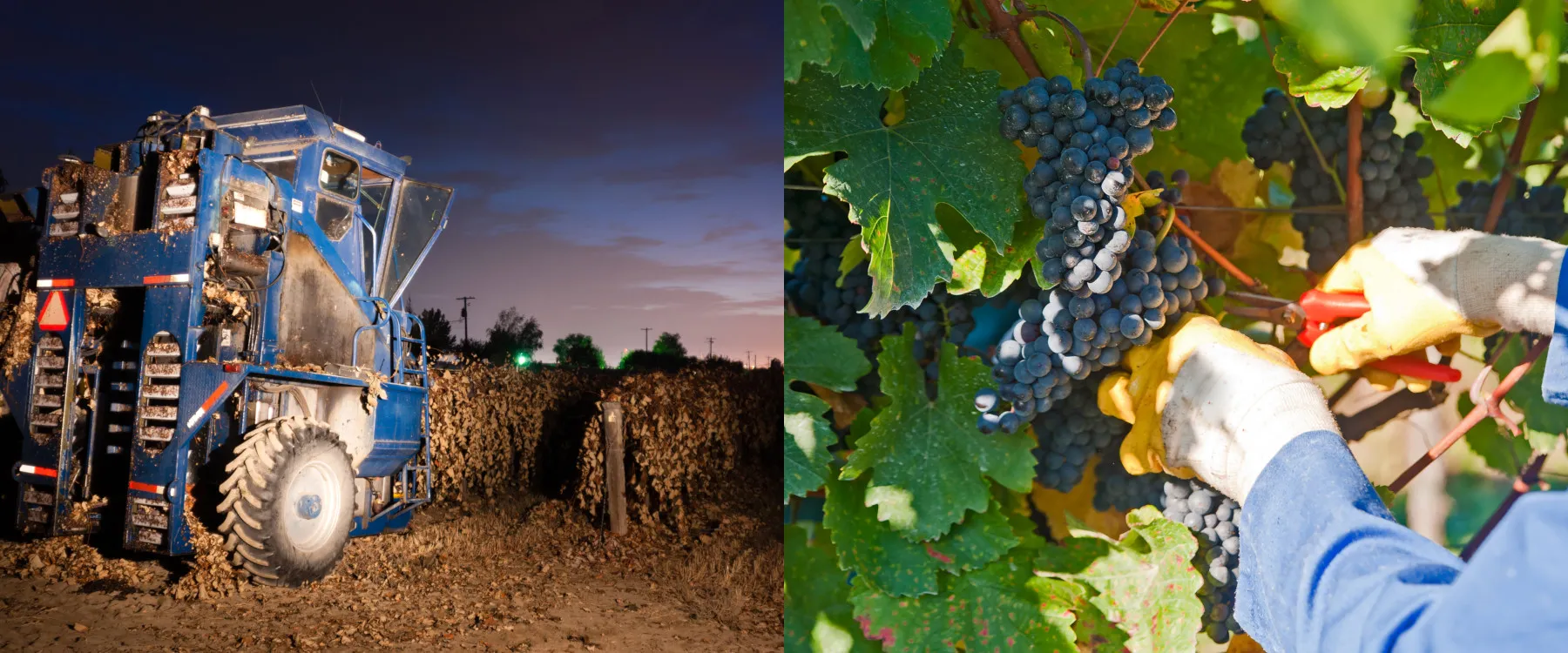
It is four o'clock in the morning, and the moon bathes the Napa Valley vineyards in a ghostly pale light. A mechanical harvester advances between the vines like a gentle giant, shaking the plants with a delicacy no worker could sustain after hours of exhausting labour. The grapes fall into the cool darkness, protected from the daytime heat that would transform the berries in a fermenting mass before it even reached the cellar. Ten thousand kilometres away, on the terraces of Valtellina, a man climbs a path that only goats would navigate with ease, the basket on his back heavy with clusters of nebbiolo gathered one by one, as they have been for centuries.
These two scenes, seemingly irreconcilable, reveal a truth that sometimes the wine world struggles to accept: in grape harvesting, there is no absolute winner between hand and machine. There is only the right question to ask—namely, what kind of wine one wishes to make.
The matter is age-old and divides experts with the same vehemence as medieval theological disputes. On one side stand the purists, convinced that the bunch must arrive at the cellar intact as nature created it, touched only by expert hands. On the other, the pragmatists, armed with data demonstrating that the latest-generation harvesters can produce results indistinguishable from—in certain cases even superior to—those of manual picking.
The figures speak clearly: in California, ninety per cent of grapes are harvested by machine. In Champagne, by contrast, the appellation rules forbid "tout moyen ne permettant pas la récolte de grappes de raisin entières"—any method that does not allow the collection of whole bunches. This is not an explicit mandate for hand-picking, but with current technology the effect is the same: conventional harvesters, which shake the vines to detach individual berries, cannot operate in the region. A rule that could change if the robots now in development prove capable of detaching whole clusters as a human hand does. The reasoning behind such caution is technical: to produce a white wine from black grapes—as is the Champenoise tradition—the bunch must arrive intact at the press. Canon Godinot wrote as early as 1718 that these wines should be "clear as tears from the eyes," and to achieve such purity "the sooner the grapes are pressed, the whiter the wine will be." In other words: no prematurely broken skins, no must in contact with the pomace before its time.
But the real question is not whether the machine is good or bad. It is where and when it makes sense to use one.
Stefano Nera, who together with his brother Simone runs Casa Vinicola Pietro Nera, founded in Chiuro in 1940, knows the difference well. On the terraces of Valtellina, where 2,500 kilometres of dry-stone walls support vineyards that defy gravity, mechanical harvesting is not an option: quite simply, no machine exists capable of climbing slopes that exceed thirty per cent. "To cultivate a vineyard on flat land requires three hundred, four hundred hours of work per year per hectare," Nera explains. "Here we need twelve hundred. It's an entirely different story." A story of toil, certainly, but also of necessity: without those hands, these vines would return to forest within a few years.
CERVIM, the Research Centre for Mountain Viticulture, has defined precise criteria for what it calls "heroic viticulture": gradients over thirty per cent, altitude above five hundred metres, cultivation on terraces or small islands. In these places—from Valtellina to the Cinque Terre, from the Amalfi Coast to Pantelleria—mechanisation remains an impossible dream. In the Cinque Terre, some vineyards are accessible only by boat.
And yet, where the machine can reach, technology has made giant strides. Modern harvesters no longer beat the vines as the first models of the 1970s did. Today they shake, at frequencies calibrated to the hundredth of a hertz. A study from the University of Bologna published in the journal OENO One demonstrated that with the right settings and appropriate post-harvest treatments, "mechanical harvesting does not have a negative influence on wine composition." The most significant difference concerns phenolic compounds, slightly lower in wines from mechanical harvest due to early oxidation of broken berries. But even this problem now finds a technological solution.
Optical sorters represent perhaps the greatest revolution in winemaking of recent decades. Machines like the Pellenc Selectiv' Vision 3 or the ALIEN robot—tested as early as 2017 at Château Calon Ségur and Haut Bailly, Bordeaux nobility not known for compromising on quality—analyse every single berry in thirty milliseconds. High-speed cameras compare shape, colour, size and structure against ideal parameters set by the winemaker. A blast of compressed air ejects anything that fails to match: unripe berries, raisins, leaves, stem fragments. "It's amazing technology," one producer interviewed by Pellenc commented. "It removes microscopic particles that no human eye could identify, impossible to sort by hand."
Juan Muñoz-Oca, head winemaker at Columbia Crest Winery in Washington State, handles fifteen thousand tonnes of grapes per harvest. "There's quite a difference between handling five tonnes at a small winery and processing what we work with here," he observes. For him, optical sorting has meant eliminating the "background noise" that can obscure varietal expression. In Canada, one producer uses the machine's four selection levels to create different wine lines: the strictest setting, which rejects even perfect berries with tiny stem fragments attached, produces the very top wines.
Then there is the advantage of night harvesting. In warm regions like Australia, southern California or Sicily, picking at night means bringing grapes to the cellar at temperatures of fifteen or twenty degrees Celsius rather than the forty of midday. The difference, for the freshness of the final wine, can be decisive. A team of human pickers could not maintain the necessary efficiency for hours in darkness; the machine can.
The cost factor remains: manual harvesting costs roughly three times more than mechanical. A gap that inevitably translates into the price for consumers. Wines from heroic viticulture—Sciacchetrà from the Cinque Terre, Sforzato from Valtellina—start at forty or fifty euros a bottle and can easily exceed one hundred. The market absorbs them because they are niche products, destined for those seeking the unrepeatable.
For fresh, young wines intended for more everyday consumption, however, mechanisation proves not only acceptable but sometimes preferable. For a Prosecco that must reach the table with all its fragrance intact, for example getting the grapes to the cellar as quickly as possible is crucial. The machine, which harvests in hours what would take days, guarantees that speed.
Marty Spate, a Californian producer, sums up the shift in perspective well: "If someone had told me in 2005 that one day I'd be making hundred-dollar bottles with machine-harvested fruit, I would have laughed. But we live in a very, very different world now." A world where technology does not replace tradition but stands alongside it. Where the ancient gesture of the picker and the hum of the optical sorter can coexist in the same winery, each serving a different wine.
On the terraces of Valtellina, meanwhile, the baskets continue to climb and descend. Not from nostalgia for the past, but because in certain places the future has no other possible form than that of a hand grasping a bunch of grapes.